


A $420,000 bull might grab the headlines, but the real business starts after the hammer falls.
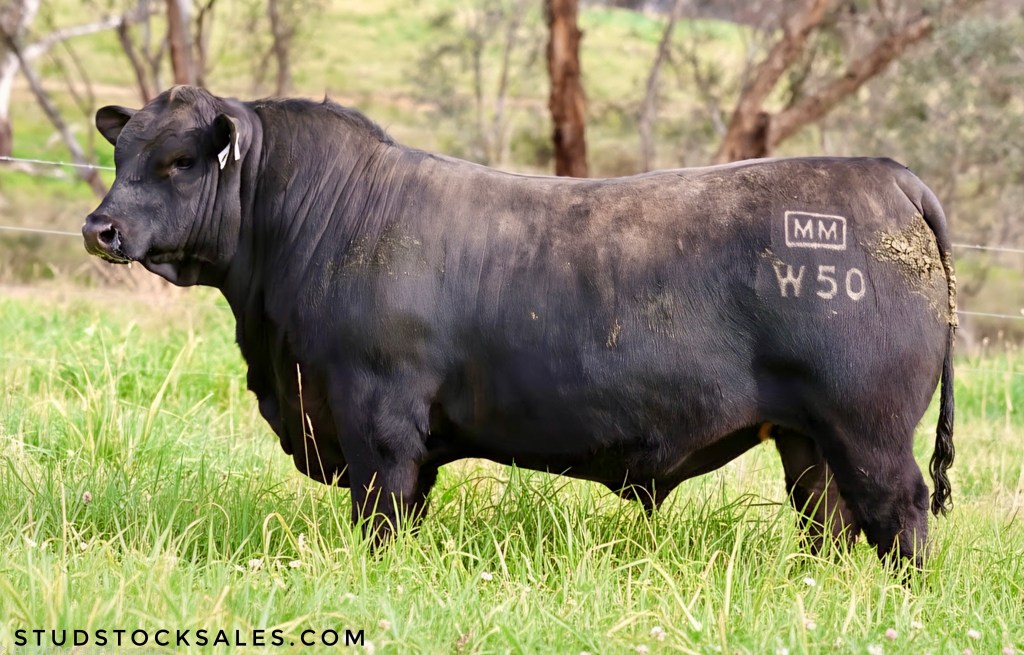
Millah Murrah Wyatt W50 became Australia’s highest valued beef animal when he sold for a record $420,000 at the Millah Murrah Angus sale near Bathurst last week.
Now attention has turned to how genetics from one extraordinarily valuable animal will move into cattle herds across Australia – and potentially around the world.
ABS Global has secured the global semen marketing rights to Wyatt.
For ABS Australia Beef Product Manager Fletch Kelly, securing the rights is part of a much bigger job – understanding what beef producers are looking for and finding genetics capable of delivering it.
He said Wyatt stood out across what ABS described as the “golden triangle” of pedigree, performance and phenotype.
“Wyatt’s pedigree is an outcross to many other Millah Murrah bloodlines that are out there, particularly those bloodlines that our customers have purchased from us previously,” he explained.
“In terms of phenotype, he is really hard to fault. Wyatt W50 has a true stud sire’s head, displays incredible length and excellent muscle expression throughout. Structurally he is super sound and has an excellent disposition. In terms of his EBV performance data, he offers really versatile breeding values across the board.”
Wyatt’s Estimated Breeding Values (EBV) profile is among the most balanced ABS had seen from a Millah Murrah bull.
Fletch said this matters because ABS isn’t simply looking for the highest-priced or most talked-about animal, the bull must first-and-foremost be a solid fit for its customer base.
In Wyatt’s case, Fletch said the attraction was his ability to offer producers a rare all-round package rather than excelling in just one area.
“Everyone wants the ultimate all-rounder,” he said.
“Firstly, it’s hard to find an outcross pedigree and data combination like that anywhere especially when you factor in his awesome looks.”
Buying semen, not the bull
ABS does not own Wyatt.
The bull was purchased by Gundungarra Angus and JS Grazing, with Millah Murrah retaining 20 per cent semen interest.
Spokesperson for the bull owners, David Croker said they were pleased to be working with ABS Australia.
“We are looking forward to tapping into the global reach of the company,” he said.
“They have a good track record, and ABS came in with a very good offer.”
Securing the rights to market semen is a common arrangement within the genetics industry. It allows an artificial breeding company to take elite genetics to a much larger customer base without purchasing the animal outright.
Fletch said ABS originally wanted to purchase Wyatt, but the eventual $420,000 price put ownership beyond where the company could go.
The value for ABS instead lies in securing access to genetics it believes its customers want.
Semen is expected to initially sell at about $300 a dose, with indicative volume pricing of $300 a dose for 20 units and $250 for 50, subject to collection capacity and supply – both to be determined soon.
Fletch said the price reflected the quality and rarity of Wyatt’s genetic package as well as expected demand.
Semen collected from Wyatt can potentially create thousands of progeny across many different herds and countries.
ABS had already received inquiries and orders within 24 hours of securing the rights, predominantly from seedstock producers but also from commercial beef businesses.
Interest was coming from Australia and overseas.
Wyatt will head to Total Livestock Genetics at Camperdown, Victoria, for semen collection, with ABS building an inventory capable of supplying customers well beyond the bull’s working life.
Fletch said semen could potentially remain commercially relevant for many years, particularly from an animal expected to leave valuable females.
“There is the genetic side of things, but there’s also the female quality side of things too,” he said.
“This will be a bull that produces females that, in 15 or 20 years’ time, will still be very relevant for beef producers everywhere in Australia and internationally.”
It is ultimately how the economics of a $420,000 bull can stack up across the supply chain.
The owners hold an exceptionally valuable animal. ABS provides the route to market. And producers buying individual doses gain access to genetics they otherwise could never afford to own.
For ABS, the record price is almost secondary.
The investment is in knowing what its customers want – and securing access to it.

