Publish date: 12.3.25
It’s Sire Summary week, a perfect time to reflect on the advancements our industry has made! Some will remember where we’ve been, while others envision where we will go. The truth is: dairying has evolved, and most of it is due to technology and automation utilization, genetic progress, and on-farm management practice changes.
Additionally, there are notable industry changes, including a rising average herd size and a gene pool that is now more safeguarded than ever. A current shift in how farmers get paid for their milk has also occurred, increasing the demand for protein. Finally, improved fertility continues to be a need for producers globally, because pregnancy is one of the most important events that occurs on a dairy.
Our Commitment to YOUR SUCCESS
Because of these changes, plus the adoption of a sexed and beef strategy, new tool development, and index formulation updates, several years ago, we made the decision to adjust how we create genetics. We specifically wanted to balance the scale with Protein because of the significant improvements made in Fat, leading us to adapt an ABS internal selection index to better serve our customers.
Our focus is not on what the industry deems as ‘ideal’ but in helping dairies create the right cows for their system: healthy, long-lasting, productive cows that aren’t too thin, dairy, tall, small, or narrow. We aim to create diverse, balanced sires that are strong for fertility, health, and milk and help our customers PROFIT FROM GENETIC PROGRESS.
Balanced Sires: What does that mean and why does it matter?
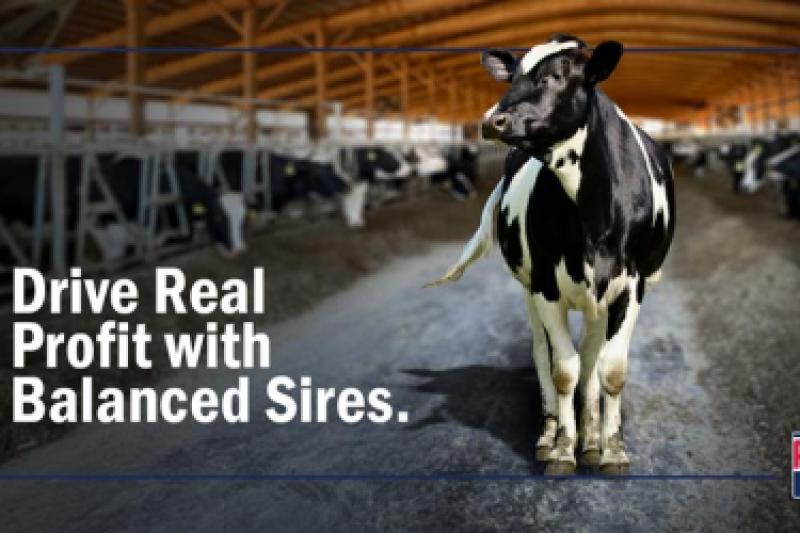
For a quick English lesson, let’s review what balanced means: having good or equal amounts of all the necessary parts of something. This perfectly depicts what a balanced bull is. They transmit well for all the key profit traits and are very easy to use on a dairy.
Balanced sires are real all-arounder bulls with lots of strengths and very few weaknesses.
What are your greatest needs as a dairy producer? When asked this, you might think of things like:
- Milk
- Protein
- Fertility
- Conception Rate
- Productive Life
- Somatic Cell Score
We agree with you and suggest deploying balanced sires in your herd. Why? Because the strength of balanced bulls lies in their ability to positively impact many key traits to dairies—improving profitability, efficiency, and sustainability simultaneously. Chasing extremes in only one area can have detrimental implications elsewhere, which is why we recommend diverse, balanced sires. They drive genetic progress, efficiency, and profit without the fear of setbacks.
Balanced Sires That Will Drive Value
- In the current ABS lineup, consider 29HO22124 BARNES, 29HO21723 MILWAUKEE, 29HO21810 PALOMA, and new graduate 94HO21962 BLISS.
- For December Sire Summary releases, check out 29HO22165 VIENNA and 29HO22106 SAMBA.
Productive Life: Great Strength
It is no secret that ABS has had historical strength in Productive Life (PL). Think of ABS greats like KED OUTSIDE JEEVES—the “Productive Life King.” Or, you may recall DIE HARD. These famous PL greats had high customer satisfaction because regardless of geography, dairy producers love to watch cows grow to be old cows. Seeing long-lasting, productive cows brings a smile to their face. Productive Life is vital to a dairy, affecting many key areas of an operation like culling rate, milk production, replacement rate, beef cross production, operational efficiency, emissions intensity, and sustainability.
Positive impacts of Productive Life are:
- Delayed culling
- Lower expenses
- More milk
- Smaller number of replacements needed
- Increased beef cross production
- Increased genetic progress
- More selection intensity for replacements
- More revenue
Older cows produce more milk and reduce the need for more replacements, opening up more pregnancies to be used in beef cross production and generating increased profit all around.
Who will create more Combined Fat and Protein in a typical 33% cull rate herd?
- A high production bull with +150 CFP
- A balanced bull with +110 CFP but +1 PL higher

Productive Life Stars of This Generation
- 29HO21740 PUZZLE with a +5.9
- 29HO22166 VICTORY with a +5.6 (a new graduate December Sire Summary)
- 29HO21938 HIGHLIFE-P with a +5.6
- 29HO21951 BREVITY with a +5.4
- 29HO21641 MYSTERY with a 5.4
Tools to Assess Your Herd’s Reproductive Efficiency
As mentioned above, one of the most important events on a dairy is a cow getting pregnant, making reproduction efficiency vital. Each animal that remains open after a pregnancy check means more time until that animal starts another lactation, more labor to get her pregnant during the next service, and more investment in resources needed to get her pregnant. There are two tools you can use to evaluate reproduction: Cow Conception Rate (CCR) and Daughter Pregnancy Rate (DPR).
CCR is the percentage of inseminated cows that become pregnant at each service and is shown as the difference from the average conception rate of the base population. For example, a bull with a CCR value of 1 implies that the conception rate for his daughters is estimated to be 1% higher during lactation than for daughters of a bull with an evaluation of 0. If you breed 100 cows, one point on conception rate means one more confirmed pregnancy, which represents an animal who has crossed a key milestone to punch her ticket to the next lactation.
DPR is defined as the percentage of cows that become pregnant every 21 days compared to the average pregnancy rate of the base population. The trait’s equation assumes a 50-day voluntary waiting period. A DPR of 1 on a bull’s proof tells us that daughters from him will average 4 fewer days open in their lactation. One day open can cost anywhere from $2 to $6, so a point of DPR is valued between $8- $24 per daughter per lactation in cost savings.
CCR Improving Sires
- 29HO21876 LORENZO with a +2.1
- 29HO21913 BRESCIA with a +1.9
- 29HO21892 DONCASTER with a +1.8
- 29HO22168 DYNAMITE with a +1.8
- 29HO21723 MILWAUKEE with a +1.7
December 2025 Sire Summary Results: Key Influential Sires
We launched 36 new Holstein graduates today that are sired by 22 different sires and from 18 different MGS—showing our commitment to genetic diversity. These bulls add new strengths to our lineup.
29HO20684 LEEDS added 63 new milking daughters and now has 104 daughters milking and ranks as No 6 NM Proven bull in the breed. Just as in August, he remains everything he has always been—elite production, CFP, and Productive Life—and the highest proven NM$ bull at ABS. His 41 sons available today average $925 NM with +1406lbs Milk!
December saw a new dawn of different bloodlines entering the lineup.
- 29HO21543 CATAPULT added 4 new sons to take his total in the lineup to 17.
- 29HO21541 LODI added his first released sons with 5 new launches bred from 4 MGS, all of which rank inside the top 20 TPI bulls available at ABS.
In the UK, for the first time in living memory, we have the new number 1 PLI bull at £871, who was born and bred in the UK! 29HO22532 COYOTE-P is a Klassic x Benefit that is 3367 TPI and $958 NM and from a famous De-Novo donor cow named CARLA. She has numerous sons in our program, and her other son 29HO22530 CHARISMA *RC also debuted in the top 10 for PLI, with more CARLA sons to be launched in the next 6 months.
We launched 5 new graduates for Jerseys, and all are ready to produce Sexcel semen. These bulls average 176 JPI and $600 CM with 29JE04612 MIDVALE ranking in the top 10 CM$ bulls in the industry. Our Jersey pipeline is also flying with 9 of the top 10 JPI bulls in the breed any age calling ABS home; expect to see these exciting new bulls in the lineup in the coming months!
As we turn the page on another Sire Summary, it is clear that regardless of where you are in the world, ABS has the right genetics, tools, programs, and people to help you profit from genetic progress. We want to help you create a genetic plan that is tailored to your herd, maximizes your milk check by focusing on your market, and minimizes your daily challenges by helping you improve weaknesses.
To profit from genetic progress with ABS today, contact your ABS Genetic Advisor or complete the form below.